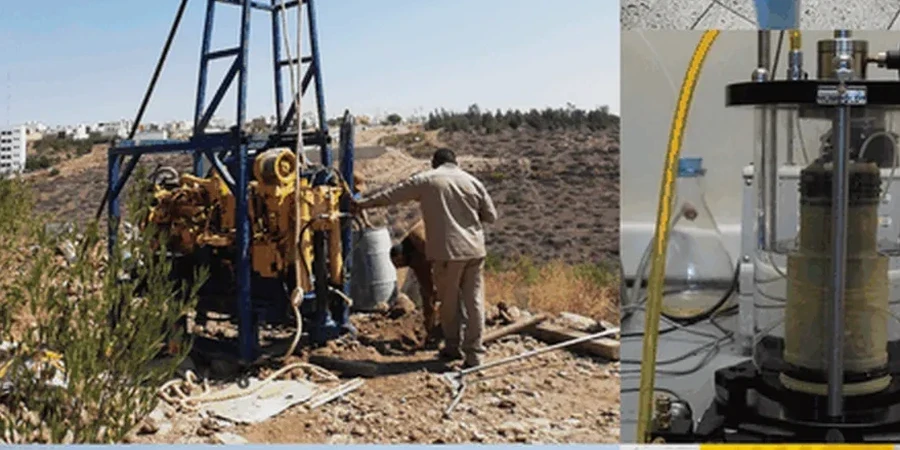
The ground beneath Mississauga tells a complex story, one that shifts dramatically from the dense Halton Till plains near the airport to the sensitive Queenston Shale bedrock along the Credit River valley. With over 720,000 residents and a construction boom reshaping the city’s skyline, understanding the soil's mechanical behavior before breaking ground has become a non-negotiable step. A soil mechanics study in Mississauga must contend with the legacy of glacial Lake Iroquois, which left behind laminated clays and silts that can lose strength when saturated during spring thaw. In our background, what appears as firm ground in August can turn into a workability challenge by November. The interaction between foundation elements and this layered geology is something we analyze using both laboratory consolidation tests and field data gathered from in-situ permeability assessments, which help us anticipate how water will move through varved deposits under future loading conditions.
In Mississauga, the difference between a successful foundation and a costly settlement problem often lies in correctly interpreting the preconsolidation pressure of the glacial clay.
Regulatory framework
Ontario Building Code (OBC) Division B, Part 4, CSA A23.3-14 – Design of Concrete Structures, ASTM D1586 – Standard Test Method for SPT, ASTM D2435 – One-Dimensional Consolidation Properties, CFEM (Canadian Foundation Engineering Manual, 4th Ed.)
Quick answers
How much does a soil mechanics study cost for a single-family home in Mississauga?
For a typical residential lot in Mississauga, a soil mechanics study including a drill rig mobilization, two to three boreholes, laboratory testing for index properties and shear strength, and an interpretative report generally ranges from CA$3,760 to CA$7,600. The final cost depends on access constraints, depth to bedrock, and the number of samples requiring advanced testing like consolidation.
What is the typical depth of investigation for a low-rise building in Mississauga?
We usually extend boreholes to a depth of at least 1.5 times the width of the proposed footing below the bearing level, or until we encounter competent bedrock. In practice, across much of Mississauga this means drilling between 8 and 15 meters through the Halton Till and into the top of the Queenston Shale to confirm refusal and evaluate the transition zone between soil and weathered rock.
How long does it take to receive the final report after fieldwork is completed?
Routine laboratory tests such as moisture content, Atterberg limits, and grain size analysis can be completed within five to seven business days. If consolidation testing is required to assess settlement potential in the clay, the report delivery extends to approximately three weeks because of the time needed for incremental loading stages. We always supply preliminary bearing values within 48 hours of drilling so the structural team can proceed with foundation sizing while the full report is being finalized.