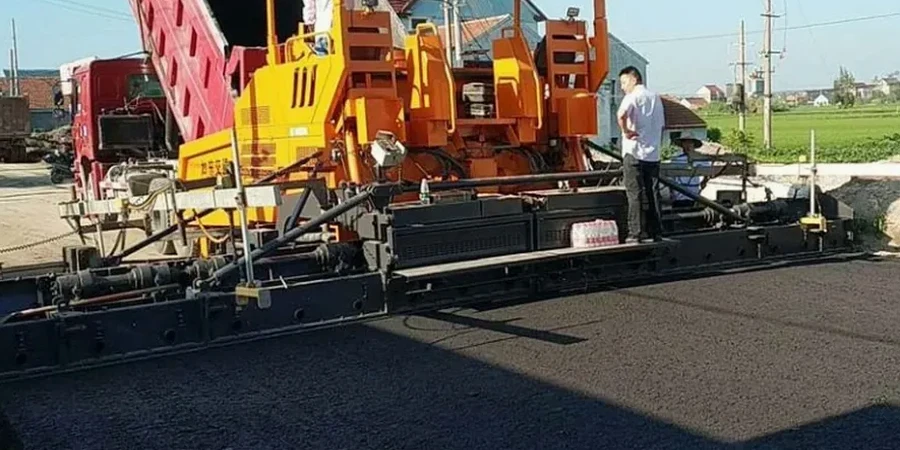
The first thing that rolls onto any Mississauga site is the nuclear density gauge and a loaded triaxial compactor, because getting the asphalt thickness right here starts with what lies underneath. Mississauga sits on the Halton Till, a dense, silty clay with scattered boulders deposited by glacial retreat, which means subgrade behavior can shift dramatically across a single subdivision lot. We correlate CBR road testing data with grain-size distributions from the till matrix to establish a resilient modulus that reflects actual seasonal conditions, not just textbook values. Since the city enforces strict pavement condition ratings under its Transportation Master Plan, we also pull historical distress data from nearby arterials to calibrate our layer coefficients before the first tonne of hot mix arrives.
A Mississauga pavement section that ignores spring thaw saturation will show alligator cracking within three years—drainage design is as critical as the asphalt itself.
Site-specific factors
We were called out to a commercial plaza off Mavis Road where the parking lot had developed deep longitudinal cracks only eighteen months after paving. The original design had specified a standard 100 mm of Granular A over the native Halton Till with no subdrain, assuming the till would supply adequate drainage—a mistake we see repeatedly in older industrial zones of Mississauga. Core samples showed the silty matrix had retained meltwater through two spring cycles, reducing the subgrade CBR from an as-constructed 5% to below 2% in the saturated state. The repair required full-depth reclamation with 4% cement stabilization to a depth of 300 mm, followed by a properly graded aggregate base and a new 180 mm three-layer asphalt system. The key lesson: in Mississauga’s till deposits, subgrade moisture control is not optional, and a design that works in Toronto’s sandy plains will fail here unless it accounts for the low permeability and high frost susceptibility of the local geology.
Quick answers
How much does a flexible pavement design for a Mississauga commercial parking lot typically cost?
For a standard commercial parking lot in Mississauga, the combined geotechnical investigation and pavement structural design typically ranges from CA$2,130 to CA$7,350, depending on the number of test pits or boreholes required and the traffic loading analysis. Sites with poor subgrade conditions near the Credit River floodplain tend toward the upper end because of the additional CBR testing and drainage design needed.
What subgrade conditions in Mississauga require lime or cement stabilization?
When the in-situ CBR of the Halton Till falls below 4%, or when the plasticity index exceeds 15, stabilization becomes necessary to meet the structural requirements of OPSS 313. We typically specify 3–5% cement by dry weight for silty clay subgrades in Mississauga, verified through unconfined compressive strength testing at seven days of curing.
How do you account for freeze-thaw damage in the pavement design?
We design the granular base and sub-base to a combined thickness that exceeds the local frost penetration depth for Mississauga, which is 1.5 m per the Ontario Building Code. Additionally, we specify non-frost-susceptible granular material (less than 5% passing the 0.075 mm sieve) and incorporate a positive drainage layer to prevent water accumulation and ice lens formation during the winter cycle.
What is the expected design life of a flexible pavement in Mississauga’s arterial roads?
For a properly designed and constructed flexible pavement on a major Mississauga arterial like Burnhamthorpe Road, the structural design life is typically 20 years for the asphalt layers, assuming a terminal serviceability index of 2.5 and periodic surface course overlays at approximately 10–12 year intervals. The actual performance depends heavily on subgrade drainage maintenance and winter salt management.