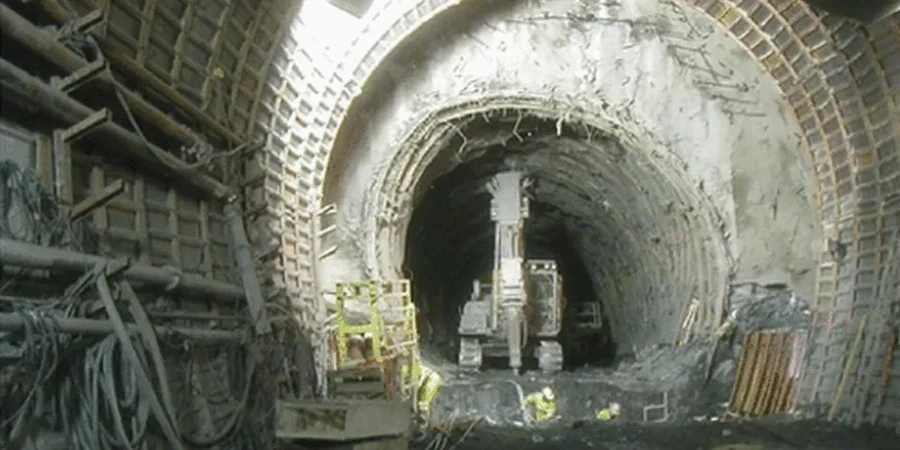
Tunneling through Mississauga's geology demands a rigorous approach that starts long before the first cutterhead turns. The city sits on thick sequences of glacial Lake Iroquois deposits — interbedded silty clays, clayey silts, and occasional sand lenses with high moisture content and low undrained shear strength, typically ranging from 20 to 50 kPa in the upper 15 meters. NBCC 2020 and CSA A23.3 set the structural design framework, but the real challenge lies in characterizing the transitional zones where competent till gives way to soft varved clay without warning. An incomplete geotechnical model here translates directly into face instability, excessive surface settlement, and groundwater inflows that can stall a project for weeks. Our technical team has been involved in multiple TBM and SEM projects across the GTA West corridor, and we have learned that the stratigraphic profile can shift by three meters or more within a single block. The CPT test becomes particularly valuable in these glacial sequences — its continuous tip resistance and pore pressure data reveal thin drainage layers that conventional SPT spacing would miss entirely.
Predicting the settlement trough shape in Mississauga's varved clays is not an academic exercise — it determines whether the gas main under Burnhamthorpe Road needs to be relocated before the TBM passes.
How we work
Mississauga's population now exceeds 720,000, and the ongoing densification around the Hurontario LRT corridor and the Lakeview Village redevelopment has pushed underground infrastructure into soil units that were historically avoided. The city's average elevation of 156 meters above sea level masks a subsurface that drops into deeply incised bedrock valleys filled with compressible organic silts — the old Credit River paleochannels that run diagonally under the downtown core. When designing a tunnel alignment through these conditions, we quantify three parameters obsessively: the overconsolidation ratio (OCR), which in Mississauga's upper crust typically falls between 1.5 and 3.0; the coefficient of lateral earth pressure at rest (K0), often underestimated in these lightly overconsolidated deposits; and the small-strain stiffness degradation curve that governs settlement trough width. Consolidation settlements under drained conditions can reach 80 to 120 millimeters in the deepest clay pockets, and the time-rate curve often shows a pronounced secondary compression tail due to the organic content. We run triaxial CIU and CAU tests with bender elements on every major unit to capture Gmax, and we calibrate all numerical models against pressuremeter data from the same horizon. Borehole televiewer surveys help confirm the absence of open fractures in the underlying shale of the Georgian Bay Formation, which can act as vertical conduits if not properly grouted during excavation.
Site-specific factors
The Meadowvale area and the Port Credit lakeshore represent two starkly different soft-ground risk profiles within Mississauga. Meadowvale sits on thicker, more uniform clay tills with lower permeability, where the dominant failure mode is time-dependent consolidation settlement propagating upward through the cover; structures within the settlement trough can background differential movement over months, not hours. Port Credit, by contrast, lies on a thin clay veneer over fractured shale, with the water table tidally influenced and perched lenses of sand that can fluidize under excess pore pressure during TBM advance. A tunnel alignment that transitions from one regime to the other — as the proposed Dundas Street relief sewer does — must be modeled with staged construction sequences that account for the sharp change in face stability conditions. We routinely run 3D finite element analyses with coupled consolidation to distinguish between undrained excavation response and long-term dissipation, because the contractual implications of misclassifying a clay as "stiff" versus "soft" can run into seven figures in change orders and delay claims.
Quick answers
What is the typical cost range for a soft soil tunnel geotechnical investigation in Mississauga?
A comprehensive program including deep boreholes with sampling, triaxial testing, and a CPT campaign generally falls between CA$5,700 and CA$19,980, depending on the number of investigation points, depth to bedrock, and the complexity of the laboratory testing suite required by the design team.
How do you determine whether an EPB or slurry TBM is better suited for Mississauga clay?
The decision hinges on the plasticity index and the percentage of fines passing the #200 sieve. Our lab runs a full suite including fall cone Atterberg limits and hydrometer analyses. When the clay fraction exceeds 40% and the PI is above 25, EPB mode with appropriate foam conditioning is typically more economical and provides better face control in the varved sequences found across the city.
How deep do you need to drill for a tunnel investigation in the Greater Toronto Area?
We typically extend boreholes to at least two tunnel diameters below the invert, or a minimum of five meters into competent Georgian Bay Formation shale — whichever is deeper. In Mississauga's paleovalleys, that often means drilling to 35 or 40 meters to confirm bedrock quality and rule out the presence of karstic features in the underlying limestone.
Can you characterize the squeezing potential of the clay before the TBM enters a zone?
Yes, we use the combination of OCR profile, in-situ lateral stress measurements from pressuremeter testing, and undrained triaxial tests to calculate the radial convergence. Squeezing is considered a risk when the ratio of overburden pressure to undrained shear strength exceeds six, a condition we have mapped in several deep sections under the Credit River floodplain.