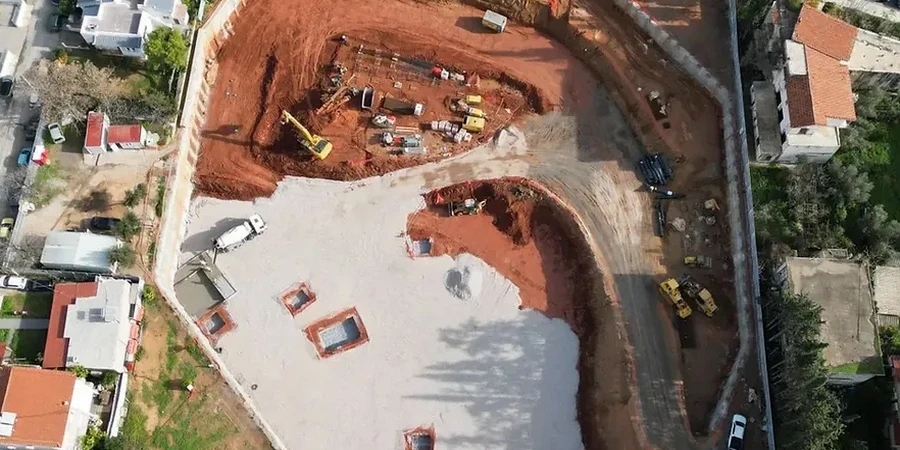
The distinctive sound of a Caterpillar 349 excavator with a 15-meter reach bucket is a common backdrop across Mississauga's evolving skyline. As the city pushes for intensified development around Square One and along the Hurontario LRT corridor, deep excavations are reaching into the Halton Till and Georgian Bay shale formations that define the region's subsurface. These over-consolidated glacial deposits, deposited over 12,000 years ago, present a unique challenge: they stand near-vertically when first exposed but relax rapidly with prolonged unloading. Designing a stable 18-meter cut on Hurontario Street is a vastly different problem from the 8-meter basements typical in the residential zones of Lorne Park. The geotechnical approach here must account for the Queenston Shale's swelling potential and the perched groundwater tables common in the Cooksville area, where infiltration through fractured till can destabilize shotcrete lagging within hours of exposure.
Base stability in Mississauga's Georgian Bay shale is not just about undrained shear strength—it is a direct function of the time-dependent relaxation of locked-in horizontal stresses.
Site-specific factors
The geotechnical risk profile varies dramatically between Mississauga's northern and southern sectors. In the Meadowvale area, excavations encounter hard, intact till that provides excellent stand-up time but requires heavy rock-breakers for penetration, increasing vibration concerns for adjacent Bell Canada fiber-optic corridors. Contrast this with the Port Credit waterfront, where excavations below Lake Ontario's historical shoreline interact with loose, saturated alluvial deposits. Here, basal heave becomes the dominant failure mode—a scenario where the weight of the surrounding soil exceeds the strength of the floor, causing a catastrophic uplift. The presence of artesian conditions in the Lower Ordovician bedrock, if not properly vented, can produce a sudden blowout with flow rates exceeding 200 liters per minute. Incorporating a deep excavation monitoring program with automated total stations becomes essential to detect millimeter-scale movements in real time, protecting both the shoring integrity and the nearby mid-rise residential structures that characterize much of the city's urban fabric.
Quick answers
What is the typical cost range for a geotechnical deep excavation design in Mississauga?
The engineering fee for a deep excavation design typically ranges from CA$2,590 to CA$9,770 depending on the complexity of the soil profile, the depth of the cut, and the number of adjacent structures requiring settlement analysis. A simple 6-meter basement in competent till will be at the lower end, while a complex 15-meter excavation with tie-backs and groundwater control in the Port Credit area will be at the higher end.
How does the Queenston Shale affect deep excavation design in Mississauga?
The Queenston Shale, encountered at depths of 10 to 15 meters in much of Mississauga, is notoriously susceptible to swelling and slaking upon exposure to air and water. The design must specify a protective coating or a short exposure window for the bedrock surface. Additionally, the shale's bedding planes can create wedge-type failures, requiring oriented rock coring to map joint sets before finalizing the bench geometry.
When is a tie-back anchor system preferred over internal bracing?
Tie-back anchors are almost always preferred for wide excavations in Mississauga where internal rakers would obstruct the construction sequence. However, they require permission to drill beyond the property line, which is not always granted by adjacent landowners. In tight urban sites near the Square One district, internal bracing or top-down slabs often become the only viable solution despite the logistical challenges they present.
What real-time monitoring is used during excavation?
We implement a combination of inclinometers installed behind the shoring wall, optical survey prisms on adjacent buildings, and vibrating wire piezometers to track pore pressure dissipation. The data is reviewed daily against pre-defined threshold values. If lateral movement exceeds 25 mm or settlement approaches 10 mm, the construction sequence is adjusted immediately to install additional bracing or concrete struts.