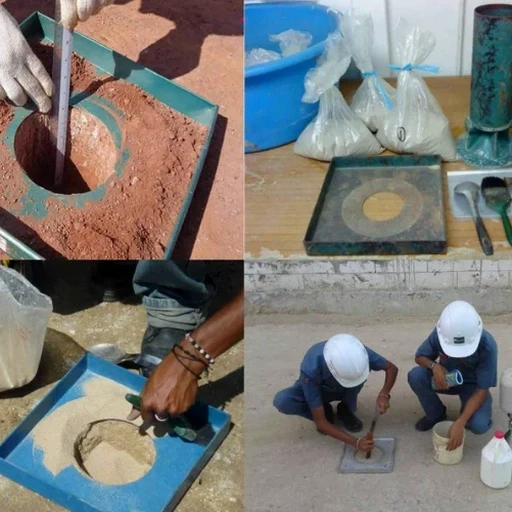
The sand cone apparatus is deceptively simple—a double-valve jar, a precisely machined cone, and Ottawa sand graded uniformly between 0.30 and 0.60 mm. We set it on a leveled base plate, dig a neat hole with a spoon and trowel, and weigh every gram of excavated soil. In Mississauga, where glacial till and clay plains dominate the landscape, field density testing catches compaction failures before they become settlement claims. The Halton Till underlying much of the city is a dense, silty clay matrix with embedded stones—it compacts unpredictably unless you monitor lift thickness and moisture. We run this test on trench backfill along the Erin Mills Parkway widening, on granular subbase under warehouse slabs near Meadowvale, and on structural fill behind retaining walls where the Credit River floodplain introduces variable moisture. Combined with grain size analysis to confirm material gradation, the sand cone results tell you whether your crew achieved the specified relative compaction before the paving crew arrives.
A sand cone test takes twenty minutes in the field, but skipping it on a single lift of structural fill can cost months in settlement remediation.
Site-specific factors
The National Building Code of Canada references CSA A23.1 for compaction of engineered fill, and in Mississauga that standard gets tested every spring. Frost penetrates 1.2 metres into the silty clay soils across the city, and the freeze-thaw cycle undoes marginal compaction in a single season. We have measured density drops of 8 to 12 percent in clay backfill that was placed at the wrong moisture content in November, left to freeze, and thawed by March. The second risk is more local: the shale bedrock of the Georgian Bay Formation weathers rapidly when exposed, producing a slick, low-friction fill that compacts poorly and swells with water. Contractors who use weathered shale as structural fill under footings in the Erin Mills or Streetsville areas without density verification end up with differential settlement and cracked slabs. The sand cone test catches these problems during construction—not two years later when the warranty claim lands on the desk.
Regulatory framework
NBCC (National Building Code of Canada) — structural fill and compaction acceptance, CSA A23.1 — concrete materials and methods, including fill preparation, ASTM D1556 — standard test method for density of soil in place by the sand-cone method, ASTM D698 / D1557 — standard and modified Proctor compaction tests, MTO LS-206 / OPSS 501 — Ontario provincial compaction specifications (referenced in municipal contracts)
Quick answers
What does a field density test cost in Mississauga?
For a standard sand cone density test in Mississauga, budget between CA$120 and CA$220 per test point, depending on the number of points per site visit and travel distance. A typical half-day with five to eight points on a single site falls in the lower end of that range. We supply a fixed quote before mobilizing so there are no surprises.
How deep can the sand cone test measure?
The sand cone method measures the density of the compacted lift or layer where we excavate the test hole. We dig to the full depth of the lift—typically 150 to 200 millimetres for granular fill and up to 300 millimetres for cohesive fill placed in thicker lifts. If you need density at greater depths, we combine the sand cone with drive-tube sampling or recommend CPT testing for continuous profiling.
Can you test density on crushed stone or coarse gravel?
Yes, but with caveats. The sand cone method works up to a maximum particle size of about 50 millimetres—beyond that, the test hole becomes too large for practical calibration. On open-graded crushed stone like Granular A with few fines, we also run a plate load test because the sand cone can overestimate density when large particles create bridging. We discuss the right method for your material before the crew arrives on site.