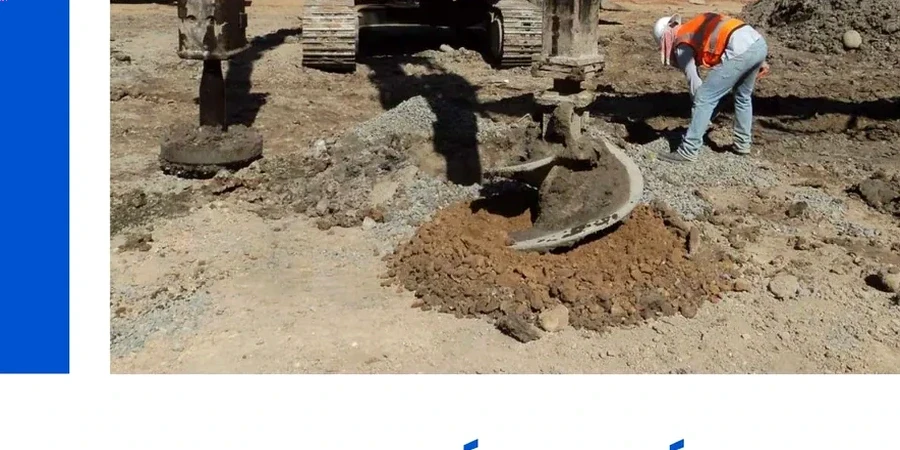
In Mississauga, a lot of the industrial land near the Pearson Airport corridor and the Lake Ontario shoreline sits on compressible clay and silty deposits left by glacial Lake Iroquois. You see it in the borehole logs time and again: 8 to 15 meters of soft material before hitting competent till or shale. Standard shallow footings just cannot perform in those conditions without excessive settlement. The practical alternative we apply on these sites is designing a load-transfer grid using stone columns. The approach uses controlled vibro-replacement to create dense, vertical inclusions that stiffen the soil matrix. Before we finalize any column spacing, the CPT testing data gives us a continuous profile of tip resistance and sleeve friction, which we correlate directly with the required replacement ratio. In several warehouse expansions north of the 401, we have seen that integrating this with a liquefaction assessment study becomes critical once the seismic hazard values from the NBCC 2020 are factored in.
A well-designed stone column grid in Mississauga's glacial clays can cut total settlement by half while providing a reliable drainage path for excess pore pressures.
Site-specific factors
The Queenston Shale bedrock beneath Mississauga is deep in most areas, but the overlying Halton Till is often interlayered with pockets of loose water-bearing silt. When a stone column installation punctures these pockets without proper confinement, the vibroflot can create a 'washout' zone that weakens the column and leaves a poor load path. The biggest design mistake is treating the entire site as uniform when the glacial stratigraphy is actually highly variable across just 50 meters. We have reviewed jobs where a single borehole was used to design a grid for a 20,000-square-foot building, and the result was differential settlement near the old creek beds that cross under the Meadowvale area. A proper site investigation, combined with SPT drilling to verify blow counts at multiple locations, eliminates this guesswork. The design must also account for the long-term relaxation of the soil between columns, because Mississauga's sensitive clays can lose strength when remolded during installation.
Quick answers
What is the typical cost range for stone column design in Mississauga?
For a standard commercial or light industrial site in Mississauga, the engineering design and reporting for a stone column ground improvement program runs between CA$1,820 and CA$8,120, depending on the treated area and the number of design iterations required to optimize the grid.
How deep can stone columns be installed in Mississauga soils?
In the soft glacial clays typical of Mississauga, effective treatment depths reach 12 to 15 meters. Beyond that depth, the vibroflot efficiency drops off and the column continuity becomes harder to assure without switching to a bottom-feed system.
Does the design change if the site is close to the Lake Ontario shoreline?
Yes. Nearshore sites in Mississauga often have a higher water table and more organic silts. The column design must include a higher replacement ratio and possibly a pre-drilling phase to prevent the native soil from collapsing into the hole before the stone is placed.
What seismic considerations apply to stone columns in Mississauga?
Mississauga falls within a moderate seismic hazard zone under NBCC 2020. The stone column design must address the potential for cyclic softening in the treated mass and verify that the improved ground can maintain its stiffness during the design earthquake without generating unacceptable settlements.