← Home · Investigation

Cone Penetration Test (CPT) in Mississauga: Fast, Reliable Soil Profiling

Together, we solve the challenges of tomorrow.

LEARN MORE →

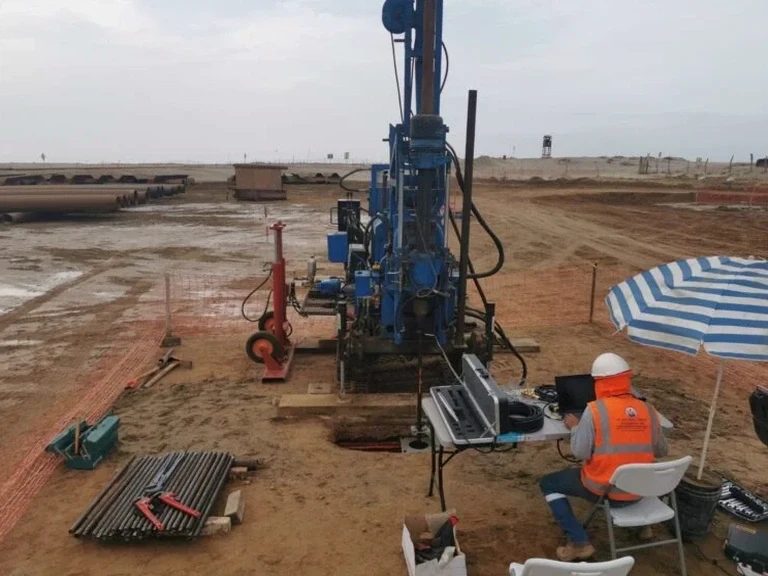
Too many Mississauga projects rely on sparse borehole data and end up with surprise soft zones during excavation. The result is delay claims and expensive over-excavation. The Cone Penetration Test eliminates that gamble by delivering a continuous, high-resolution soil profile before shovels hit the ground. Our field crew operates a 20-tonne CPT rig capable of pushing through the dense Halton Till that underlies much of the city, reaching depths of 25 to 30 meters in competent ground. For sites near the Credit River or along the Lake Ontario shoreline, where organic silts and loose fills are common, we often pair the CPT program with test pits to visually confirm the near-surface stratigraphy and with SPT drilling when disturbed samples are required for lab classification. The rig mobilizes quickly across Mississauga, from Meadowvale business parks to Port Credit infill lots, with minimal site preparation and zero drilling mud.

A single CPT sounding replaces several boreholes for stratigraphic profiling, cutting site investigation time by half on most Mississauga commercial lots.

How we work

On Mississauga sites, we consistently see a sharp contrast between the stiff clay till of Streetsville and the compressible deposits in the Cooksville area. This variability is exactly where CPT data pays for itself. The test records cone tip resistance, sleeve friction, and dynamic pore pressure simultaneously every 2 centimeters. That resolution catches thin sand seams and weak clay lenses that a standard borehole log would miss. For deep foundation design, the corrected cone resistance directly feeds bearing capacity calculations under NBCC 2015 and the CFEM guidelines. When liquefaction assessment is triggered by the site's seismic class, the CPT data is processed using the Robertson method to estimate the factor of safety against cyclic softening. The same data set also supports settlement analysis and lateral pile response. On industrial projects requiring ground improvement, the pre- and post-treatment CPT profiles give an objective measure of compaction effectiveness, and we often cross-reference the results with a plate load test to confirm the modulus of the treated ground. All sensors are calibrated to ASTM D5778 standards in our Mississauga lab before mobilization.
Cone Penetration Test (CPT) in Mississauga: Fast, Reliable Soil Profiling
Technical reference image — Mississauga

Site-specific factors

A waterfront site in Port Credit and an industrial lot near Pearson Airport present completely different geotechnical risks, even though both are in Mississauga. The Port Credit property likely sits on soft lacustrine clays with high sensitivity and a shallow water table that complicates deep excavations. CPT pore pressure dissipation tests here are critical to estimate the consolidation rate and avoid heave during construction. Near the airport, the overconsolidated Halton Till provides excellent bearing but may contain cobbles and boulders that can refuse the cone. In either scenario, ignoring the lateral variability of the deposit is the fastest way to trigger a differential settlement problem. A grid of CPT soundings across the building footprint reveals the geometry of compressible pockets and lets the structural engineer decide between a uniform mat foundation or targeted ground improvement. For multi-storey structures in Mississauga's seismic zone, the shear wave velocity profile from a seismic CPT is essential input for a site-specific liquefaction assessment and foundation design compliant with NBCC

Need a geotechnical assessment?

Reply within 24h.

Email: info@geotechnicalengineering.co

Technical data

ParameterTypical value
Cone capacity100 MPa (15,000 psi)
Maximum depth (typical)25–30 m in Halton Till
Data interval20 mm (continuous)
Measured parametersqc, fs, u2 (piezocone)
Sleeve friction range0–1 MPa standard
Pore pressure transducer0–3.5 MPa range
Inclination monitoringBuilt-in inclinometer
Seismic module (SCPT)Vs measurements available

Associated technical services

01

Standard Piezocone (CPTu)

Continuous profiling of tip resistance, sleeve friction, and pore pressure. Ideal for stratigraphic mapping and foundation design in Mississauga's complex glacial deposits.

02

Seismic CPT (SCPT)

Downhole shear wave velocity measurement at selected intervals. Used for seismic site classification per NBCC and liquefaction triggering analysis.

03

Dissipation Testing

Pore pressure decay monitoring to estimate in-situ consolidation characteristics. Critical for projects in Mississauga near the Credit River or Lake Ontario where silty clays govern settlement time.

Regulatory framework

ASTM D5778 – Standard Test Method for Electronic Friction Cone and Piezocone Penetration Testing, NBCC 2015 – National Building Code of Canada (Seismic Site Classification), CFEM – Canadian Foundation Engineering Manual (4th Edition), CSA A23.3 – Design of Concrete Structures (Foundation references), MTO LS-704 – Ontario Ministry of Transportation CPT specification

Frequently asked questions

What is the typical cost of a CPT test in Mississauga?

For most Mississauga projects, CPT testing ranges from CA$240 to CA$320 per meter of sounding, depending on depth, site access, and whether seismic or dissipation modules are required. Mobilization is quoted separately based on the number of soundings and the location within the city. A typical commercial building investigation with four to six soundings will fall within this unit rate range.

How deep can a CPT rig penetrate in Mississauga soils?

In the dense Halton Till that covers much of Mississauga, our 20-tonne rig routinely reaches 25 to 30 meters. Penetration stops when the cone tip resistance approaches the 100 MPa limit of the load cell or when refusal on a boulder is detected. In softer deposits near Lake Ontario, depths of 35 meters or more are achievable without reaching refusal.

Is CPT accepted for foundation design under the Ontario Building Code?

Yes. Cone Penetration Test data is fully accepted under the National Building Code of Canada (NBCC), which governs in Mississauga, and is referenced extensively in the Canadian Foundation Engineering Manual. The geotechnical engineer of record uses the CPT parameters to derive bearing capacity, settlement, and liquefaction potential for the foundation design submission.

Do you need to drill a borehole alongside the CPT?

Often yes, but fewer boreholes are needed. A common approach in Mississauga is to perform several CPT soundings to map the stratigraphy continuously and then drill one or two boreholes at key locations to recover samples for laboratory testing. This hybrid investigation cuts the overall cost and provides both high-resolution in-situ data and material samples for index testing.
Location and service area

We serve projects in Mississauga and surrounding areas.

View larger map