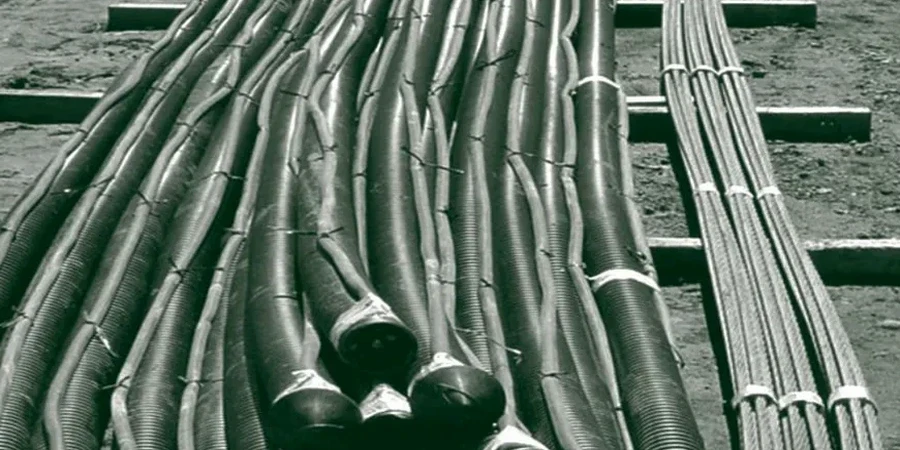
A 30-meter excavation near Square One encountered basaltic bedrock at 18 meters. The shoring design required a double row of passive anchors to manage the lateral thrust from the dense Halton Till before hitting the Queenston Shale. Mississauga's variable overburden demands a precise differentiation between active and passive anchor systems. Active anchors are pre-stressed to control movement in sensitive adjacent infrastructure. Passive anchors are only engaged when deformation occurs, making them ideal for massive bedrock blocks. The lock-off load in a strand anchor must account for the creep characteristics of the local silty clay. Every design submitted in Mississauga must align with the Ontario Building Code's deep foundation requirements.
Lock-off load verification in Mississauga's Halton Till prevents long-term creep failure in pre-stressed ground anchors.
Quick answers
What is the difference between active and passive anchors in a Mississauga context?
Active anchors are stressed immediately after installation to apply a pre-compressive load to the soil or rock mass, which prevents movement. This is critical near Mississauga's sensitive transit corridors. Passive anchors develop their resistance only when the ground mass moves and are typically used in competent Queenston Shale where minimal deformation is expected.
How do you verify the capacity of an anchor in the Halton Till?
We perform a performance test by incrementally loading the anchor to 133% of the design load and measuring the total movement. The residual movement after unloading must fall within the criteria specified by the PTI DC35.1 guidelines. This confirms the bond zone in the till is not undergoing plastic creep.
What is the cost range for anchor design and testing in Mississauga?
The engineering design and load testing package for active/passive anchors in Mississauga typically ranges between CA$1.400 and CA$5.380, depending on the anchor capacity and the number of sacrificial test anchors required by the ground conditions.
Is double corrosion protection required for temporary shoring?
For temporary anchors with a service life under 24 months in non-aggressive soils, single corrosion protection may be acceptable. However, given the variable groundwater chemistry and potential de-icing salts in urban Mississauga fills, we often recommend Class I protection even for temporary works to maintain bond integrity.