← Home · Seismic

Base Isolation Seismic Design in Mississauga: Protecting Structures from Ground Motion

Together, we solve the challenges of tomorrow.

LEARN MORE →

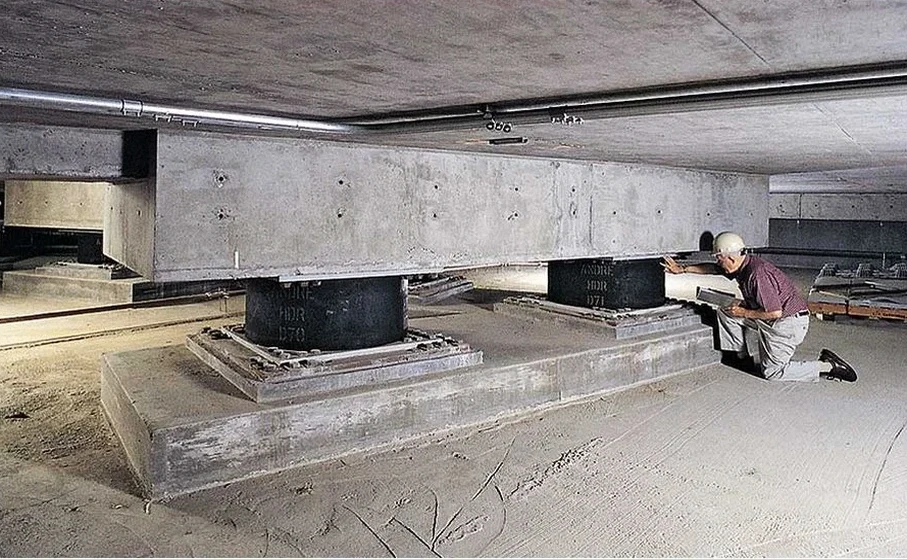
The lead-rubber bearings arrive on a flatbed, each unit weighing over a ton. In Mississauga, installation crews position these isolators between the foundation and the superstructure—creating a physical separation that changes how seismic energy enters a building. Unlike conventional fixed-base design that stiffens a structure to resist shaking, isolation lets the ground move while the building above stays largely still. Our engineering team models site-specific spectra for Mississauga’s glacial till and shale bedrock, matching isolator properties to both near-field and distant-source earthquakes. For complex sites near the Credit River valley, we integrate the seismic refraction survey data to constrain shear-wave velocity profiles before isolator specification begins. The isolators themselves combine natural rubber layers with steel shims and a lead core, providing both flexibility and damping in a single device that sits quietly beneath occupied floors.

A properly isolated building in Mississauga can reduce seismic forces by 60 to 80 percent compared to fixed-base design—without increasing structural member sizes.

How we work

Mississauga’s transformation from farmland to Canada’s sixth-largest city brought rapid high-rise construction onto soils that vary dramatically—dense Halton Till in the north, softer lacustrine deposits near Lake Ontario. This geological patchwork means seismic demand at bedrock doesn’t translate uniformly to the surface. A base-isolated hospital in Streetsville and a conventional apartment tower a kilometer apart may experience completely different ground motions during the same event. Our analysis process starts with probabilistic seismic hazard assessment per NBCC 2020, then develops site-specific response spectra using borehole data and downhole measurements. Where soil amplification is significant, we model the combined effect of site class and isolator period shift. The shear wave testing campaign defines the upper 30 meters’ velocity profile—a parameter that directly influences spectral acceleration values fed into isolator design. Every project receives a peer-reviewed analysis package documenting the effective period, equivalent viscous damping, and displacement demand under the design earthquake.
Base Isolation Seismic Design in Mississauga: Protecting Structures from Ground Motion
Technical reference image — Mississauga

Site-specific factors

Mississauga sits in a moderate seismic zone, but the real risk lies underground. Soft lake-bottom clays in the Port Credit area can amplify long-period ground motion—exactly the frequency range where base-isolated structures are most sensitive. A miscalculated isolator period that accidentally matches the soil’s natural frequency creates resonance instead of protection. Then there’s the frost penetration problem. Isolators at grade level must remain accessible for inspection yet protected from freeze-thaw cycles that degrade elastomeric materials over a 50-year service life. The moat detail—the gap that allows 400 mm of lateral movement—must accommodate snow accumulation without jamming. During the 2010 Val-des-Bois earthquake, buildings in Quebec experienced prolonged shaking at periods above 1 second; Mississauga’s deep soil sites could see similar effects from a magnitude 7 event in the Western Quebec Seismic Zone. Our design approach explicitly models these long-period hazards and verifies displacement capacity under maximum considered earthquake conditions.

Need a geotechnical assessment?

Reply within 24h.

Email: info@geotechnicalengineering.co

Technical data

ParameterTypical value
Design spectral acceleration Sa(0.2)0.33–0.48g (Site Class C–E)
Isolator effective period2.0–3.5 seconds typical
Equivalent viscous damping ratio15–30% (lead-rubber bearings)
Maximum isolator displacement (DBE)250–400 mm typical
Seismic mass tributary per isolator500–1,500 kN per unit
Analysis method per NBCC 2020Nonlinear time-history (NLRHA)
Soil-structure interaction modelingDirect or substructure approach

Associated technical services

01

Nonlinear Time-History Analysis & Isolator Specification

We select and scale ground motion records matching Mississauga’s seismic hazard deaggregation, run full 3D models in ETABS or SAP2000 with nonlinear link elements, and produce procurement specifications for lead-rubber, high-damping rubber, or friction pendulum isolators.

02

Peer Review & Construction Phase Testing

Independent design verification per Ontario Building Code requirements. We witness prototype and production testing of isolators, review moat cover details, and perform on-site quality assurance during the installation sequence.

Regulatory framework

NBCC 2020 (National Building Code of Canada) Article 4.1.8.20-21 for seismic isolation, CSA S832-14 (R2019) Guideline for seismic risk reduction of operational and functional components, CSA A23.3:19 Design of concrete structures with provisions for isolated structures, CHBDC CAN/CSA-S6-19 for isolated bridge structures where applicable, ISO 22762:2018 Elastomeric seismic-protection isolators

Frequently asked questions

What does base isolation design cost for a Mississauga project?

Engineering fees for a full base isolation design package—including nonlinear time-history analysis, isolator specifications, and construction support—typically range from CA$6,560 to CA$10,060 for a mid-rise building. The isolator units themselves are a separate procurement cost driven by the number of columns and seismic weight.

Is base isolation required by code in Mississauga, or is it optional?

The Ontario Building Code (based on NBCC 2020) does not mandate base isolation for any occupancy class. It is a performance-based design choice. Post-disaster buildings—hospitals, emergency operations centers—are the most common candidates because isolation keeps both the structure and its contents functional after a major earthquake.

How do you verify that the isolators will perform as designed over decades?

Every isolator undergoes factory production testing per ISO 22762, including compression stiffness, shear stiffness, and damping ratio verification. We specify aging and scragging test protocols that simulate the mechanical property changes expected over the building’s service life. On-site, we confirm installation geometry and witness the first cycle of lateral movement during commissioning.
Location and service area

We serve projects in Mississauga and surrounding areas.

View larger map