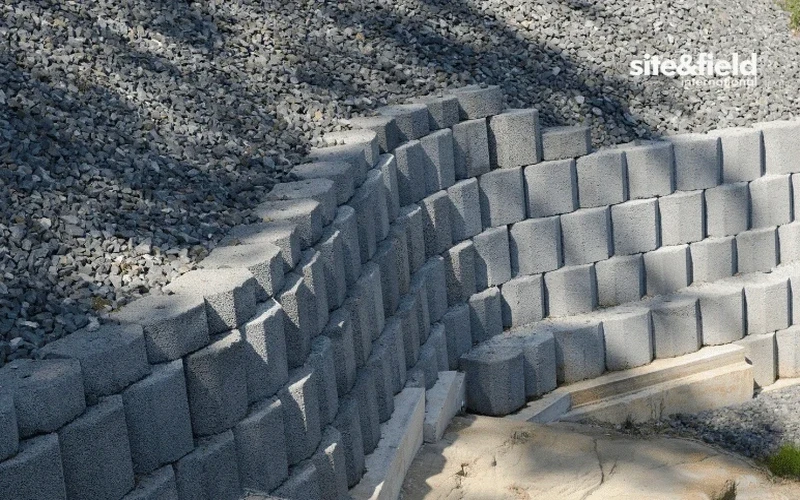
A 14-foot cut at the edge of a Credit River ravine. The contractor assumed a standard gravity wall would work. Within two weeks of backfilling, the wall rotated. The culprit was not poor construction—it was a misinterpretation of Mississauga’s Halton Till matrix, which transitions from stiff clay to silt pockets without warning. That project taught us that retaining wall design in Mississauga demands more than textbook geometry. Pulling a test pit within the first three meters of excavation gives us the visual stratigraphy that boreholes alone miss. When the till overlies Georgian Bay shale at shallow depth, we typically run a CPT test to capture the sleeve friction drop at the weathered rock interface—a detail that changes the overturning calculation entirely.
In Mississauga’s Halton Till, a 2-degree drop in the drained friction angle can increase the active earth pressure by 15%—enough to turn a stable wall into a serviceability failure.
Site-specific factors
With a population approaching 830,000 and over 500 kilometers of watercourses draining into Lake Ontario, Mississauga faces a concentrated risk of retaining wall underperformance tied to groundwater. The 2013 and 2017 flood events in the Cooksville and Port Credit areas revealed how quickly local water tables rise within the upper weathered till zone. A wall designed with drained parameters but built without a functioning subdrain becomes a dam. We have inspected walls in Lorne Park where hydrostatic pressure behind the stem exceeded design assumptions by 40%, causing vertical cracking at the cold joint. In Mississauga, the most dangerous phrase in a retaining wall specification is “weep holes to be field-located.” We pre-drill formwork for drains at 1.2-meter centers and back them with ASTM C33 filter aggregate wrapped in non-woven geotextile. On slopes exceeding 10%, we add a toe drain daylighting to the nearest swale. The cost of a proper drainage system is negligible compared to the cost of dismantling a 6-meter wall that has rotated past its serviceability limit.
Regulatory framework
CSA A23.3-19 – Design of Concrete Structures, NBCC 2020 – National Building Code of Canada (Seismic Provisions), OBC 2012 (amended 2019) – Ontario Building Code, Part 4, OPSS 1010 – Material Specification for Aggregates, CSA S6:19 – Canadian Highway Bridge Design Code (for integrated bridge abutment walls)
Quick answers
How deep a footing does a retaining wall need in Mississauga’s soil?
The Ontario Building Code requires a minimum frost cover of 1.2 meters. In Mississauga’s Halton Till, we typically extend the footing base to 1.5 meters below finished grade to get below the active frost zone and into undisturbed, overconsolidated till. If the wall is founded on weathered shale near the Georgian Bay formation contact, we may deepen the excavation to reach competent rock with an allowable bearing pressure verified by field inspection.
What is the cost range for a professionally designed retaining wall in Mississauga?
Engineering design fees for a retaining wall in Mississauga typically range from CA$1,430 for a simple lot-line wall under 1.5 meters to CA$5,670 for a full structural and geotechnical package on a commercial wall exceeding 4 meters in height. The final cost depends on retained height, proximity to slopes or watercourses, and whether a site-specific geotechnical investigation is already available.
Do I need a building permit for a retaining wall in Mississauga?
Yes, the City of Mississauga requires a building permit for any retaining wall exceeding 1.0 meter in height, measured from the bottom of the footing to the top of the wall. Walls supporting a surcharge (such as a driveway or building) require a permit regardless of height. Our design package includes the signed and sealed structural drawings and Schedule 1 forms required for permit submission.
How do you account for the shale bedrock that is shallow in parts of Mississauga?
In areas like Streetsville and along the Credit River valley, the Georgian Bay Formation shale can be encountered within 1 to 3 meters of grade. We adjust the wall design by using rock socketed shear keys or dowels to transfer sliding resistance directly to the bedrock. The passive resistance contribution of the overlying till is discounted conservatively. We also specify controlled blasting or rock hammer excavation limits if the shale is too competent for conventional equipment.