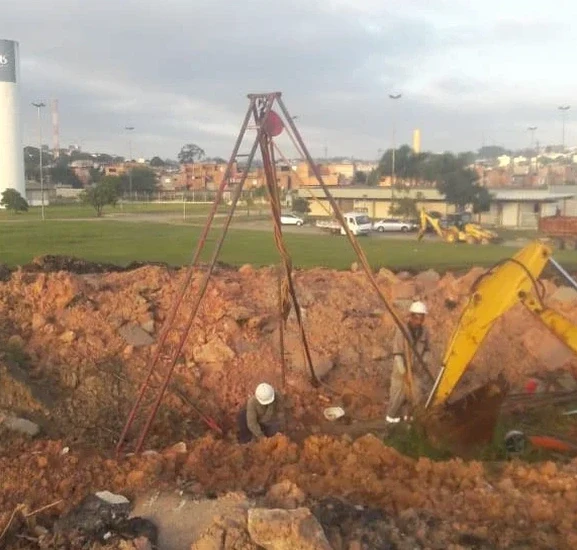
Much of Mississauga sits on the Halton Till, a dense silty clay deposited by glacial Lake Iroquois about 13,000 years ago. This material can shift from stiff to soft depending on moisture, and its behavior under load changes dramatically across the seasons. Atterberg limits testing provides the liquid limit, plastic limit, and plasticity index that engineers need to classify these fine-grained soils according to ASTM D4318 and the Unified Soil Classification System (ASTM D2487). For projects near the Credit River floodplain or in older neighborhoods around Port Credit, knowing the Atterberg limits is essential before specifying footing depths or drainage strategies. The grain-size distribution often complements this test to confirm the full particle profile, while a triaxial shear test may follow when the plasticity index indicates sensitive clay behavior.
A plasticity index above 20% in Mississauga clay signals potential shrink-swell movement that can crack shallow footings within a single wet-dry season cycle.
How we work
A commercial building on Hurontario Street recently required a full index property suite after site investigation revealed a buried lens of laminated silt. The Atterberg limits identified the material as ML-CL, borderline between silt and lean clay, with a plasticity index of 8%. That borderline classification directly affects how the soil handles freeze-thaw cycles—a real concern in Mississauga winters. The liquid limit test uses the Casagrande cup method, while the plastic limit is determined by the 3.2 mm rolling thread procedure, both in accordance with ASTM D4318. Sample preparation follows oven-drying at 110°C, and only material passing the No. 40 sieve is used. Our laboratory also runs a one-point liquid limit correlation when sample quantity is limited, though the multipoint method remains the reference for critical infrastructure. Results typically include a plasticity chart plot per ASTM D2487, which places the soil in the appropriate group symbol for geotechnical reporting.
Site-specific factors
Soil conditions in Streetsville differ noticeably from those in the Clarkson area. Streetsville sits on thicker Halton Till with moderate clay content and plasticity indices often in the 10-18% range, while Clarkson, closer to Lake Ontario, can encounter softer lacustrine clays with PI values exceeding 25%. That higher plasticity brings real shrink-swell risk: a footing designed without Atterberg data in Clarkson might background differential movement after heavy spring rains, leading to drywall cracks and misaligned door frames. Even within the same development, a change of two meters in elevation can place the foundation in a different soil unit. Without Atterberg limits, the geotechnical report lacks the quantitative index needed to flag expansive soil behavior, which the Ontario Building Code requires engineers to consider in foundation design.
Regulatory framework
ASTM D4318 - Standard Test Methods for Liquid Limit, Plastic Limit, and Plasticity Index of Soils, ASTM D2487 - Standard Practice for Classification of Soils for Engineering Purposes (Unified Soil Classification System), ASTM D2488 - Standard Practice for Description and Identification of Soils (Visual-Manual Procedure), CSA A23.3 - Design of Concrete Structures (references soil classification for foundation requirements), Ontario Building Code (O. Reg. 332/12) - Part 4, foundation provisions referencing soil properties
Quick answers
What do the Atterberg limits actually measure?
The liquid limit is the water content at which the soil changes from plastic to liquid behavior, measured with the Casagrande cup. The plastic limit is the water content where the soil crumbles when rolled into a 3.2 mm thread. The plasticity index is simply the difference between the two. Together, these numbers classify fine-grained soils and predict how they'll behave during excavation, compaction, and seasonal moisture changes.
How much does Atterberg limits testing cost in Mississauga?
For a standard set of Atterberg limits (liquid limit, plastic limit, and plasticity index) on a single sample in Mississauga, the typical range is CA$80 to CA$150. The price depends on whether it's part of a larger index property package and how quickly the results are needed. Multi-sample projects usually receive volume pricing from the laboratory.
How long does the test take from sample to report?
Standard turnaround is 3 to 5 business days. The sample needs to be oven-dried, processed through the No. 40 sieve, and then tested with both the Casagrande cup and the rolling thread procedure. Rush service can deliver results in 24 to 48 hours when the project schedule demands it, though this depends on current laboratory workload.
What sample quantity do you need for Atterberg limits?
We need at least 200 grams of material that has passed through a No. 40 (0.425 mm) sieve. If you're submitting a bulk sample from a test pit or SPT split spoon, send approximately 500 grams of representative material to ensure we have enough for the sieve preparation plus the actual limit determinations.
Can Atterberg limits identify expansive soils in Mississauga?
Yes, the plasticity index is the primary screening tool. A PI above 20% combined with a clay fraction above 30% typically indicates moderate to high shrink-swell potential. In Mississauga's glaciolacustrine deposits near the Lake Ontario shoreline, we occasionally see PI values exceeding 30%, which require specific foundation mitigation strategies such as deepened footings or moisture control measures per the Ontario Building Code.