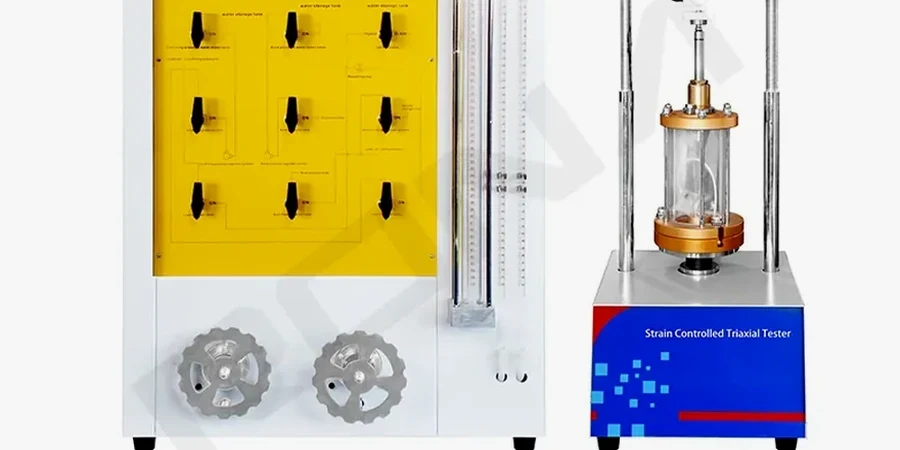
A 15-storey residential tower near Square One encountered a critical design challenge: the glacial till beneath the proposed foundation showed inconsistent shear strength across the site. The structural engineer needed more than just SPT blow counts—they required precise effective stress parameters to model settlement and bearing capacity accurately. Our Mississauga laboratory ran a series of consolidated-undrained triaxial tests with pore pressure measurement on undisturbed Shelby tube samples, providing the c’ and φ’ values that allowed the design team to optimize the raft foundation thickness and avoid costly over-excavation. In a city where the underlying Queenston Shale bedrock dips from north to south and the overburden varies from 2 meters to over 20 meters in buried valleys, a triaxial test becomes the definitive method for soil characterization. The Mississauga area’s development boom—from the M City towers to the Hurontario LRT corridor—demands geotechnical data that goes beyond index properties, and our lab delivers results that integrate directly into finite element and limit equilibrium models.
A single CU triaxial test on Mississauga Halton Till can define the failure envelope that governs foundation depth decisions across an entire subdivision.
Site-specific factors
Sites in Meadowvale and Streetsville present fundamentally different triaxial challenges. Meadowvale’s silty clay tills, when loaded, can develop excess pore pressures that take weeks to dissipate, meaning undrained strength derived from a UU triaxial test may underestimate the long-term stability if the designer doesn’t account for consolidation. Meanwhile, Streetsville’s proximity to the Credit River introduces zones of looser alluvial sand where drained triaxial testing becomes essential—an undrained test on these materials simply won’t capture the volume-change behavior critical for settlement prediction. A Mississauga engineering firm recently faced this exact problem on a stormwater detention facility where the design assumed drained parameters but the investigation report only provided unconsolidated-undrained results. The remediation cost exceeded six figures. Our laboratory protocol for Mississauga projects automatically flags soil descriptions indicating alluvial or lacustrine deposits and recommends the appropriate triaxial type before testing begins, reducing the risk of parameter mismatch between design assumptions and ground reality.
Quick answers
What does a triaxial test cost for a typical Mississauga project?
A complete triaxial testing program for a Mississauga site typically ranges from CA$2,720 to CA$4,100, depending on the number of specimens, the test type (CU, CD, or UU), and the confining stress levels required. A standard three-specimen CU suite with pore pressure measurement falls near the middle of this range. We supply a fixed quote after reviewing the borehole logs and design requirements.
How does the Queenston Shale influence triaxial testing in Mississauga?
Queenston Shale bedrock underlies much of Mississauga at depths that can vary from less than 3 meters in the north to over 20 meters in buried bedrock valleys. When the shale is weathered, it behaves as a stiff clay and can be tested in the triaxial cell. However, intact shale requires rock mechanics testing rather than soil triaxial methods. Our lab identifies the transition zone and recommends the correct test protocol.
What sample quality is required for a CU triaxial test?
We require undisturbed Shelby tube samples with a minimum diameter of 76 mm, properly sealed with wax or expanding packers immediately after extrusion in the field. Samples showing signs of disturbance—cracks, voids, or swelling—are rejected before trimming. For Mississauga’s sensitive clays, we follow ASTM D4220 procedures for sample preservation and transport.
Can a single triaxial test provide both drained and undrained parameters?
A multi-stage CU test on one specimen can supply an effective stress failure envelope, but it cannot fully replace a drained (CD) test for volume-change behavior. If your Mississauga project requires both drained stiffness for settlement analysis and undrained strength for short-term stability, we typically recommend a full suite of three CU specimens plus one CD test on a representative sample.
How long does triaxial testing take from sample delivery to report?
A standard three-specimen CU triaxial suite requires approximately 7 to 10 working days from sample receipt to final report. Consolidation phases for Mississauga’s overconsolidated tills can take 24 to 48 hours per specimen, and shearing at the prescribed slow rate may require an additional 8 to 12 hours per specimen. Expedited scheduling is available for time-sensitive projects.