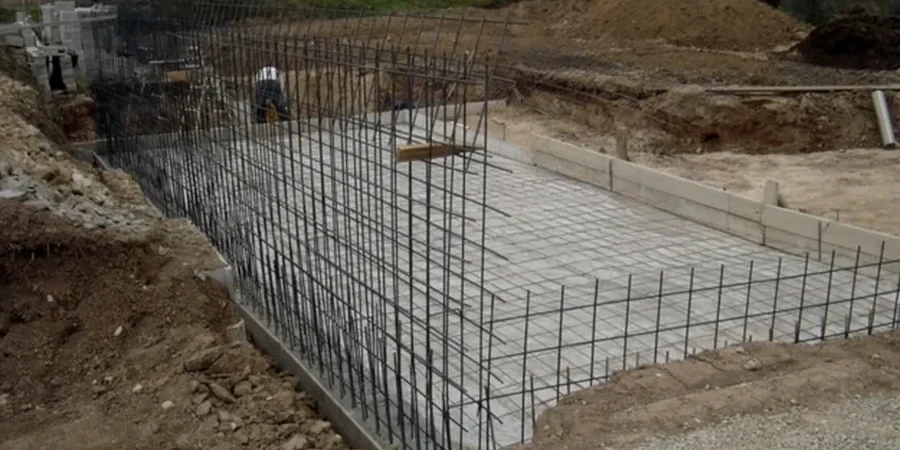
The Halton Till underlying much of Mississauga presents a classic geotechnical dichotomy. It is a dense, overconsolidated glacial deposit—often stiff enough to support significant structural loads—yet its matrix-supported texture and occasional sand lenses introduce localized compressibility risks. The water table sits relatively shallow in the Cooksville and Port Credit corridors. At the site investigation stage, confirming the till’s undrained shear strength and preconsolidation pressure becomes non-negotiable. A shallow foundation design in Mississauga must reconcile these favorable Pleistocene deposits with the city’s moderate seismic hazard classification under NBCC 2020. The design process moves beyond generic presumptive bearing values. We correlate laboratory triaxial data from Shelby tube samples with in-situ SPT drilling records to calibrate settlement predictions for isolated and strip footings. On sites near the Credit River, alluvial veneers over the till demand careful differentiation of strata before finalizing the bearing depth.
A 0.5 m embedment into unweathered Halton Till in Mississauga typically mobilizes an allowable bearing pressure between 150 and 300 kPa, provided the foundation width exceeds 0.6 m.
How we work
Mississauga’s transformation from a bedroom community to a high-density urban node placed unprecedented demand on its glacial stratigraphy. The Square One district and the Hurontario corridor required foundation solutions that addressed both the stiff upper till crust and the deeper, softer glaciolacustrine units. A shallow foundation design here integrates limit state philosophy per CSA A23.3. We calculate ultimate bearing capacity using classical Terzaghi or Vesic formulations, then apply a geotechnical resistance factor of 0.5 for bearing. Immediate settlement on the till typically remains within 15 mm for well-designed footings. Long-term consolidation settlement, however, requires careful evaluation where the foundation stress bulb intersects silt seams. The design must also consider frost protection depth, which in Mississauga extends to 1.2 m below finished grade. Seasonal groundwater fluctuations in the upper till zone are monitored via standpipe piezometers during the investigation phase. The resulting design package includes factored bearing resistance, modulus of subgrade reaction for structural modeling, and a construction monitoring schedule.
Regulatory framework
NBCC 2020 (National Building Code of Canada), CSA A23.3:19 (Design of Concrete Structures – Foundation provisions), Ontario Building Code (OBC) – Supplementary Standard SB-1, CFEM (Canadian Foundation Engineering Manual, 4th Ed.), ASTM D1194 (Plate Load Test, as applicable)
Quick answers
What is the typical allowable bearing pressure for a footing on Halton Till in Mississauga?
For a footing embedded at least 0.5 m into intact, unweathered Halton Till, we often assign an allowable bearing pressure in the range of 150 to 300 kPa. This assumes a minimum footing width of 0.6 m. The exact value depends on the SPT N-value, the proximity of the water table, and whether the till is classified as intact or reworked. Every design requires a site-specific investigation to confirm these parameters.
What is the cost range for a shallow foundation design in Mississauga?
The design fee for a new residential or light commercial foundation in Mississauga typically falls between CA$2,830 and CA$3,960. This covers the geotechnical investigation, laboratory testing, settlement analysis, and the stamped design report. Complex sites with deep fill or slope proximity may fall outside this range.
How does the NBCC seismic classification affect footing design in Mississauga?
Mississauga generally falls under moderate seismic hazard. The NBCC 2020 requires a site-specific shear wave velocity measurement to assign a Site Class. Most till sites classify as Class C or D. This classification influences the seismic design base shear and can affect foundation tie-beam requirements. The design must also verify that bearing capacity under seismic loading satisfies the factored resistance criteria in the code.